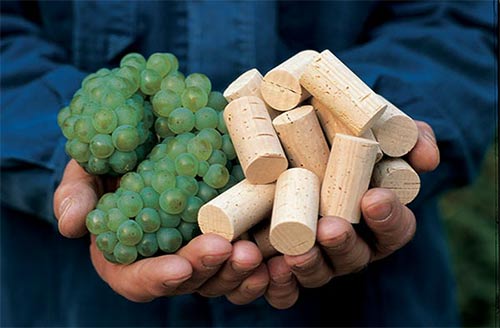
Cork - the fastener of an elixir

The problem becomes smaller visibly because one knows
his causes, in the meantime, rather well, but who is concerned by him, that
is disappointed, nevertheless. The speech is from falsifications of the wine
taste by cork. Besides, it is not the cork as such, but his extensive processing
which does him sometimes the malefactor: Cork taste is a destructive judgment
- at least for the bottle of wine which one just wanted to empty. The guest,
the customer, the epicure likes this just a little like the waiter who serves
the wine, like the winegrower who holds the test with customers.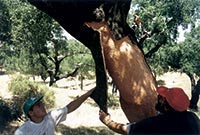
And still nobody more has been able toe changan at the time if the problem appears a little bit in it. The damage is there, compensates and only one new bottle of the same wine at least those which wanted to drink the wine. The host, the winegrower, the Sommelier stays down on the damage.
The cork be produced problem - statistically seen - in about 2% of the cases. This statistics overlooks a little thing: Cork and his twin brother called muff tone are two different Pair of shoes with different causes and causes. Cork is a natural product which one harvests by Schälung of the bark of the cork oak. Indeed, the tree with his first Schälung already has nearly 30 his up to 200 years behind itself, and only the third Schälung is suited for excellent cork after other 18 years.
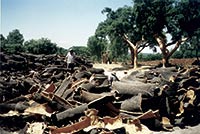 In
spite of all regeneration ability a protracted process, even if a 9-annual
cycle produces about 2.5 cms! After the harvest cork is sorted out, stacked,
selected, stored and stacked again. Almost one year has gone to the land,
before the first one-hour ablution helps to make easier the following processing
in boiling water. The next renewed storage during this time of the full maturity
and the highest flexibility serves the purpose to form level records. After
three weeks a selection occurs after thick and qualities; then the first
export push begins in form of pressed bales.
In
spite of all regeneration ability a protracted process, even if a 9-annual
cycle produces about 2.5 cms! After the harvest cork is sorted out, stacked,
selected, stored and stacked again. Almost one year has gone to the land,
before the first one-hour ablution helps to make easier the following processing
in boiling water. The next renewed storage during this time of the full maturity
and the highest flexibility serves the purpose to form level records. After
three weeks a selection occurs after thick and qualities; then the first
export push begins in form of pressed bales.
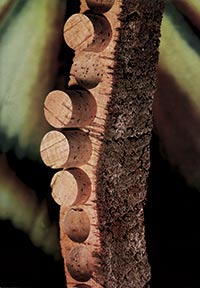
But also on site - in most cases this is the main export
land Portugal - becomes processed. The records are cut in stripe whose length
and thickness must correspond in the possibly later cork. 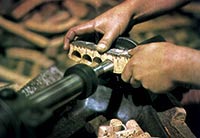 Then
raw corks are punched, from hand if it should be a good cork without rubbish
too much, automatically if one accepts lower qualities and more scrap metal.
Smooth loops and an other assortment follow - again by machine in the first
step with manual control. With the next ablution the chlorine products
which stand together with micro-organisms as a malefactor for the cork
taste in the suspicion are used. Hence, more and more suppliers go over
to ablutions free of chlorine. There occurs an other manual assortment
and segregation which ends with the last dry process. Then the corks are
packed in aerial-permeable bales to 10,000 to 20,000 pieces of uniform
qualities.
Then
raw corks are punched, from hand if it should be a good cork without rubbish
too much, automatically if one accepts lower qualities and more scrap metal.
Smooth loops and an other assortment follow - again by machine in the first
step with manual control. With the next ablution the chlorine products
which stand together with micro-organisms as a malefactor for the cork
taste in the suspicion are used. Hence, more and more suppliers go over
to ablutions free of chlorine. There occurs an other manual assortment
and segregation which ends with the last dry process. Then the corks are
packed in aerial-permeable bales to 10,000 to 20,000 pieces of uniform
qualities.
 At
this point a word must be said to the stronger and stronger widespread Presskorken.
His base material is natural also cork, indeed, as a granulate material;
the cork which was inexpedient for most different reasons for the physical
cork-production (cork wood, lacking thickness, lacking quality etc.). With
glue this granulate material is processed in different procedures to Presskorkstangen
or blocks. Of course the composition can, density, Körnung of this Presskorken
much better beeinflust and are steered than this with physical cork the case
is; the application of Presskorken still occurs with priority for short-lived
products.
At
this point a word must be said to the stronger and stronger widespread Presskorken.
His base material is natural also cork, indeed, as a granulate material;
the cork which was inexpedient for most different reasons for the physical
cork-production (cork wood, lacking thickness, lacking quality etc.). With
glue this granulate material is processed in different procedures to Presskorkstangen
or blocks. Of course the composition can, density, Körnung of this Presskorken
much better beeinflust and are steered than this with physical cork the case
is; the application of Presskorken still occurs with priority for short-lived
products.
However, at the end a product which closes one noblest of our food comes out again: delightful wine... The Romans have demonstrated it to us: they closed wine amphoras already with cork; then sometime in the history of the wine one noted that corked bottles help to increase the wine quality. Cheers!